AMJON 2026: Stakeholders seek ways for Nigeria’s efficient ports amidst emerging technology.
AMJON 2026: Stakeholders seek ways for Nigeria's efficient ports amidst emerging technology.

Titilayo Adeleke

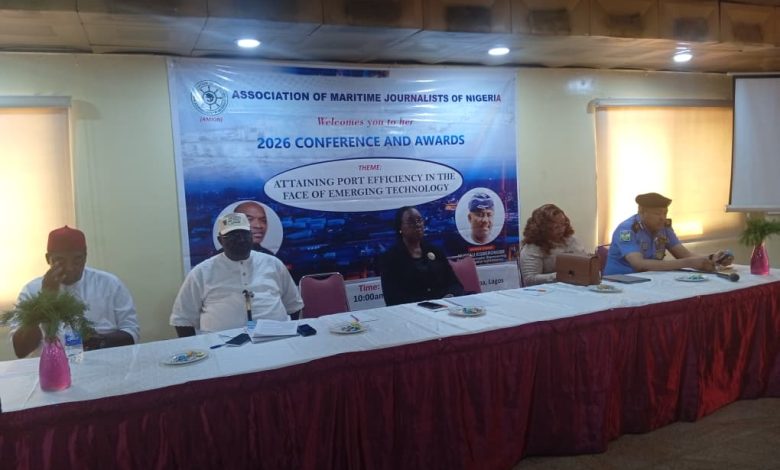
LAGOS — The Maritime Journalists Association of Nigeria (AMJON) on Thursday, gathered critical maritime stakeholders for a discourse ona attaining efficient port in the face of different trade tools across the globe.
The discourse is ostensibly, geared towards getting Nigerian ports at same pace with technological advancements in other ports and for effective competitiveness.
With the theme “Attaining Port Efficiency in the Face of Emerging Technology,” the event served as a platform for media practitioners and industry stakeholders to confront the systemic inefficiencies currently plaguing the nation’s maritime sector.
A Call for Action, Not Just Conversation
In her opening address, the President of AMJON Mrs Vera Osokpo set a definitive tone for the association’s future. She emphasized that the media would no longer act as passive observers or mere “cheerleaders” for industry stakeholders.
“We are the bridge between the policy and the ports, between technology and the truck drivers, and between the boardroom and the bedroom,” the President stated.
“When you deploy technology that works, we will amplify it. When you install scanners that gather dust, we’re going to ask, ‘Why?'”
The urgency of the moment was underscored by sobering statistics. The President cited Lagos Chamber of Commerce and Industry (LCCI) figures estimating that Nigeria loses approximately $19 billion annually due to port inefficiencies.
Furthermore statistics stated that despite 80% of the nation’s trade passing through its ports, World Bank reports consistently highlight that roughly 5% of that trade is severely hampered by operational bottlenecks.
Comparing Nigeria’s current state to its neighbors, the President pointed to the success of regional counterparts, Singapore’s AI-driven cargo clearance, Rotterdam’s blockchain-based container tracking, and Ghana’s seamless 24-hour port operations managed entirely via mobile applications.
Barrister Jean Chiazor Anishere, SAN in her keynote address, outlined five pillars necessary for Nigeria to transition from an analogue to a smart-port nation:
Artificial Intelligence: Essential for vessel scheduling, berth allocation, predictive equipment maintenance, and customs risk profiling to eliminate human discretion and corruption.
Blockchain Technology: To provide an immutable, transparent record of all transactions, reducing document fraud and unofficial levies.
The Internet of Things (IoT): Utilizing RFID tags and sensor-enabled yards for real-time cargo visibility from ship to final destination.
Automated Port Equipment: A mandatory requirement for terminal operators, specifically calling for the federal government to make automation a condition for the renewal of Build-Operate-Transfer (BOT) agreements.
Enhanced Security: Continued reliance on the Deep Blue Project and the Suppression of Piracy and Other Maritime Offences (SPOMO) Act to maintain security within territorial waters.
The conference, which hosted key industry figures including the Commissioner of Police, Western Port Authority Toyin Agbaminoja highlighted the necessity of a strong governance framework to support these technological advancements.
Speakers collectively called upon regulatory bodies including the Nigerian Ports Authority (NPA), NIMASA, and the Nigerian Shippers’ Council to accelerate the adoption of the National Single Window project and enforce stricter compliance with technological mandates.
”
The era of analogue port management is over,” the keynote address concluded. “Countries and ports that embrace technology will lead. Nigeria has the assets, the policy framework, and increasingly the infrastructure to lead in West Africa. What we need now is speed, commitment, and collaboration.”
The AMJON 2026 Conference continues with technical sessions aimed at bridging the gap between current operational challenges and the digital solutions required to ensure Nigeria remains a competitive force in global maritime trade.